
The Economics of Cloud: How Free VPS Providers Make Money?
In the world of web hosting, the most common question from skeptical users is: “If they are giving this server away for free, how do they keep the lights on?”
It is a valid question. Running a data center is an incredibly capital-intensive business. Between industrial-grade electricity, complex cooling systems, hardware maintenance, and premium bandwidth, every active server costs money every single second it runs. Yet, trillion-dollar companies like Oracle, Google, and Amazon offer “Always Free” Virtual Private Servers (VPS) to anyone with an email address.
Is it charity? Absolutely not. It is a highly calculated business strategy designed to capture market share in a ruthless industry.
In this deep dive, we analyze the five primary revenue models behind free cloud hosting. By understanding these models, you can better identify which “Free” offers are safe, and which ones are traps waiting to spring.
1. The “Loss Leader” Strategy (The Gateway Drug)
For the “Big Three” cloud providers—AWS (Amazon), Google Cloud, and Microsoft Azure—a free VPS is simply a marketing expense, similar to a Super Bowl ad.
In the retail world, a grocery store might sell milk at a loss just to get you inside, knowing you will inevitably buy bread, eggs, and cereal while you are there. In the cloud world, the free VPS is the milk.
The Ecosystem Lock-In
Cloud infrastructure is complex. Each provider has its own proprietary dashboard, API structure, and terminology (e.g., AWS calls them “EC2 Instances,” Google calls them “Compute Engines,” Azure calls them “Virtual Machines”).
The Strategy:
- They give you a micro-instance to learn their specific platform.
- You spend 50+ hours mastering the AWS interface, learning how to configure Security Groups and IAM roles.
- When you eventually land a job as a DevOps engineer or launch your own startup, you will choose the provider you already know.
The cost of hosting your tiny 1GB RAM server is microscopic—fractions of a cent per hour—compared to the potential thousands of dollars you (or your future employer) will spend with them over a lifetime.
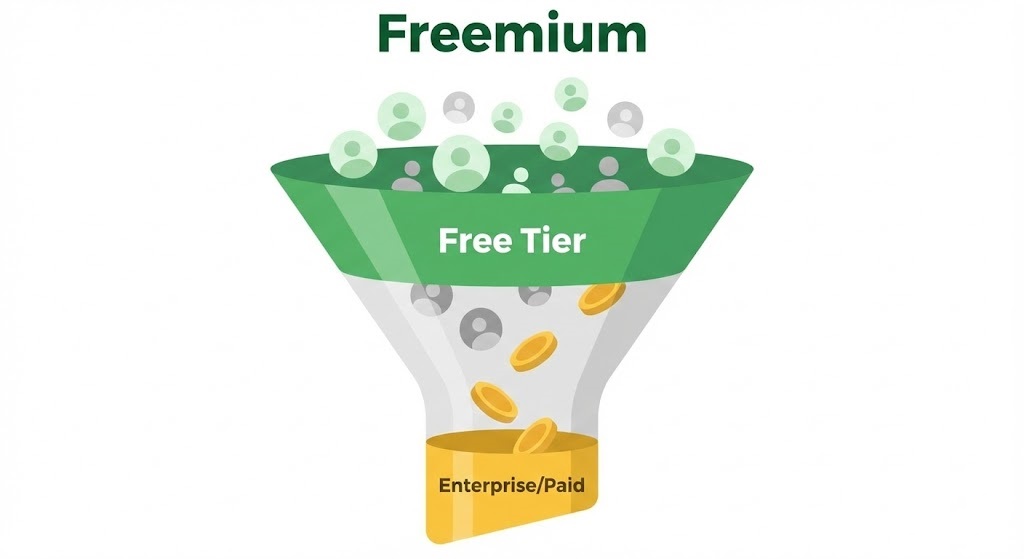
2. The “Freemium” Funnel (The Upsell Ladder)
This is the dominant model for mid-sized hosting companies and “Free Trial” platforms. The goal is to give you a taste of the service that is just good enough to start, but too weak to scale.
The Hardware Ceiling
Most free tiers come with strict hardware limitations designed to force an upgrade. For example, a provider might offer:
- 512 MB RAM: Enough for a blank WordPress site, but it will crash if you install WooCommerce.
- Shared CPU: Enough for low traffic, but the site will slow down during peak hours.
The Moment of Friction
The psychology here is simple: Migration is painful.
Once you have spent days setting up your website, configuring your DNS, and securing your SSL certificates, you are emotionally invested. When your site starts growing and hitting those hardware limits, the server will crash.
At that exact moment of frustration, the provider presents a convenient “Upgrade Now” button. For just $5/month, your problems disappear. Because migrating to a new host is a technical headache, 80% of users will simply click the button and start paying. They monetized your laziness.
3. Hidden Revenue: Egress Fees and Static IPs
Sometimes the compute power (CPU/RAM) is genuinely free, but the “accessories” required to run a server are not.
The Bandwidth Trap (Data Egress)
In cloud billing, Ingress (data coming into the server) is usually free. However, Egress (data leaving the server) is often charged.
If you host a simple text blog, this doesn’t matter. But if you try to host a file-sharing server, a Plex media server, or an image gallery, you are pushing massive amounts of data out to users. You might stay within the “free” CPU limits but get hit with a surprise bill for $50 in bandwidth fees.
The Cost of IPv4
We are running out of IPv4 addresses globally. The price to acquire a single IP address has skyrocketed. As a result, many providers (including Google Cloud and AWS) have started charging for the Public IP Address attached to your free server.
The Catch: The server itself is free, but the “door” to reach it costs $3–$4 per month. This filters out hobbyists and ensures that only serious users (who might upgrade later) sign up.
4. The Dark Side: Data Monetization
While the major providers make money through future upsells, there is a seedier side of the internet. If you find a “Free VPS” offer from a company you have never heard of, operating without a clear business address or legal page, be extremely cautious.
The Golden Rule: If you aren’t paying for the product, you ARE the product.
Sketchy providers may monetize your server in unethical ways:
- Data Scanning: Scanning your hosted files for marketable consumer data.
- Ad Injection: Injecting code or popup advertisements into your website’s HTTP traffic (common in the early 2000s, less common now due to HTTPS).
- List Selling: Selling your registration email, phone number, and usage habits to marketing aggregators.
- Crypto Mining: Using your idle CPU cycles to mine cryptocurrency in the background (this makes your server incredibly slow).
Security Warning: Always read the Privacy Policy. If a free provider claims the right to “share data with third-party partners,” do not host sensitive databases or customer information on their servers.
5. Enterprise Subsidies (The “Robin Hood” Effect)
Finally, there is the concept of Capacity Management.
Massive enterprise clients—Netflix, Zoom, Coca-Cola—pay millions of dollars a month for guaranteed cloud infrastructure. To serve these clients, providers build massive data centers.
However, servers cannot be turned on and off instantly. It is often more efficient for a provider to keep hardware running at low capacity than to have it sit completely idle. By offering free tiers, they can:
- Stress Test Networks: Use free users to test load balancing and routing optimization.
- Justify Expansion: High user numbers (even free ones) help executives justify building new data centers to investors.
In this model, the “Whales” (Enterprise clients) effectively subsidize the “Minnows” (Free users).
FAQ: Navigating the Business of Free Hosting
Why do they require a credit card for a free server?
This is primarily for Identity Verification, not billing. It stops one person from using a script to spin up 10,000 free servers to build a DDoS botnet. It also ensures that if you do exceed the free limits (like bandwidth), they have a way to recover the costs.
Will “Always Free” tiers last forever?
No business model is permanent. Terms of Service can change at any time. For example, Heroku famously ended their popular free tier in 2022, forcing millions of students to migrate or pay. While Oracle and Google have maintained theirs for years, you should never treat a free tier as a “lifetime contract.” Always keep off-site backups.
How can I avoid hidden charges?
Stick to the “Big Three” (AWS, Google, Azure) or Oracle Cloud. They have transparent billing dashboards where you can set Budget Alerts. Avoid obscure providers that promise “Unlimited everything for free,” as these are almost certainly scams or data harvesting operations.
Is it worth upgrading to a paid VPS?
For a hobby project? No. But if you are running a business, paying $5/month is often worth it just for the Customer Support alone. When a free server goes down, you are on your own. When a paid server goes down, you have a phone number to call.
Conclusion: Free VPS hosting is a legitimate part of the cloud economy, serving as a powerful marketing tool for providers and a learning resource for developers. As long as you understand the limitations and the business incentives behind the offer, you can leverage these resources safely and effectively.